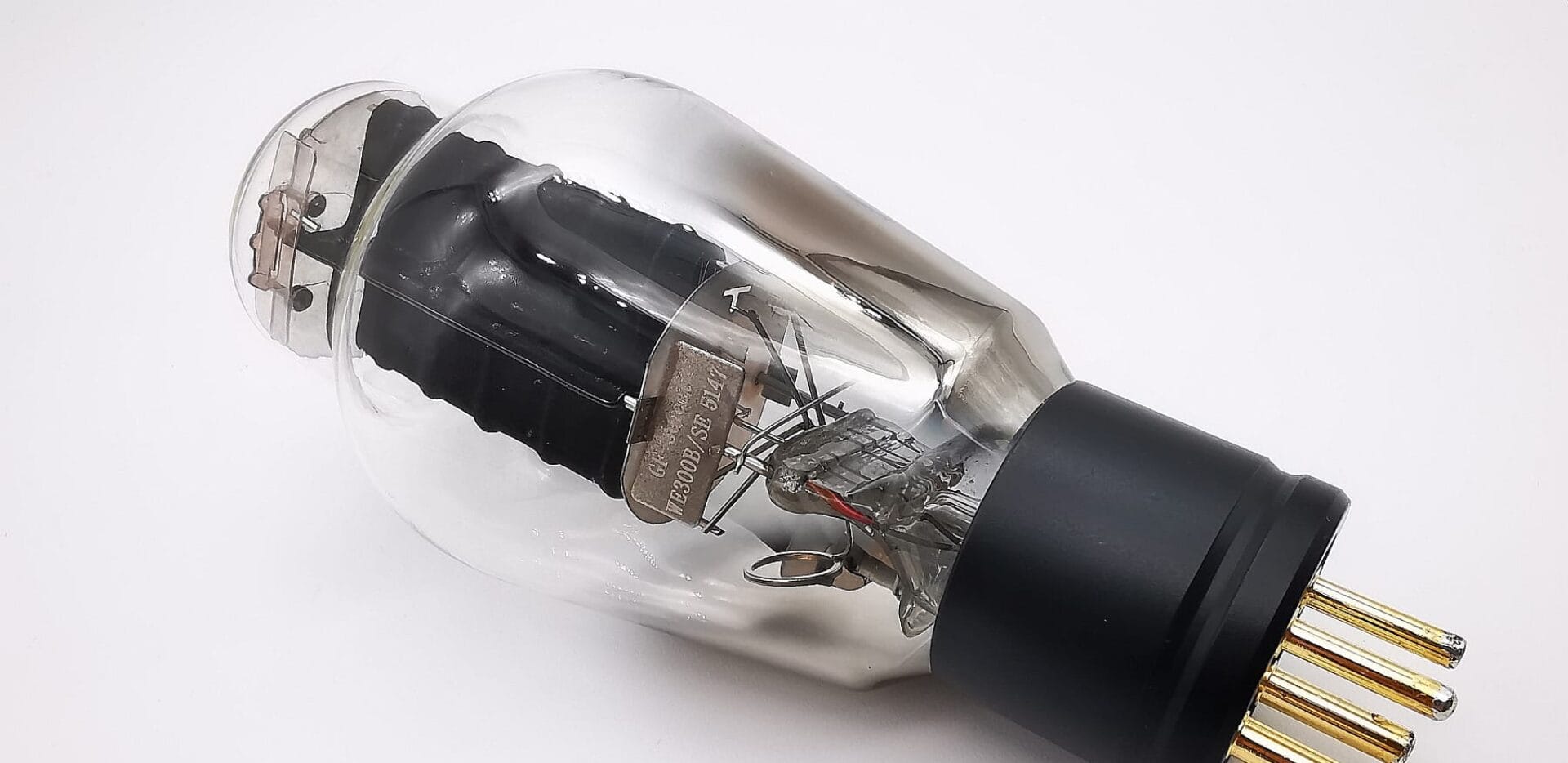
JJ 300B vs. Treasure 300B-Z
– from customer Swimjay:
“Here are some additional impressions from a new 300B Z owner, with more to follow as the tubes continue to burn in. [Associated equipment includes Cambridge Audio 840C CD player w/Dexa clock and non-standard output IC, ef86-based home made line stage, home made dual mono 300B SET amps based on Jack Elliano’s DRD design, Mapleshade interconnects and speaker wire, not-yet-released newly designed vibration dissipation devices under all electronics, and very,very highly modified Quad 63’s. These speakers are not normally associated with low power amps, but in this incarnation have such a wide dynamic range that they sound great. That is, they don’t play very loud, but retrieve low-level detail so far below the range of a normal loudspeaker they don’t need to play loud to be satisfying.]
I’ve been using JJ 300Bs, and all comparisons that follow are with those.
Right out of the box the tubes are agreeable, a bit modest (not polite), even, for the first 10 minutes, slightly pinched sounding. But quickly, the sound grows more, for want of a better word, lovely. In reading Ian’s thoughts above, I was afraid I might find an overall euphonic warmth, but this was not the case. The initial presentation is unambitious, as if no chances were being taken, but very unstrained. No one area calls out its excellence, but the overall sense is very comfortable–it doesn’t seem as if there’s going to be any suffering during the break-in period.
In a very short time–less than 5 hours–the dynamics become less constrained, individual instruments become more embedded in their surrounding space, and, at about 6 hours, one is occasionally aware that a performer is standing on a floor, something the JJ’s could never quite communicate (the JJ’s have easily in excess of 2000 hours of playing time.) Already, for classical music, I would rather listen to these than to the JJ’s. For rock, they have less “slam” (an over-used, and strange, audio review term), and less deep bass. At this stage they sound “lower-bandwidth” than the JJ’s, but the flip side of that is that they also sound less edgy, less white.
They show a greater ease at resolving lower midrange, upper bass information. So for example, if a cello and the lower strings of a violin occur together, each instrument retains its harmonic structure more completely and their sound combined is richer harmonically.
I think a part of their magic–and already they’re magical–is that the Shuguangs seem to track very well subtle variations in pitch and amplitute. A tremolo or vibrato has almost as much reality as a note played with no vibrato. And individual violin notes don’t oscillate subtly between sour and brittle, but stay centered at their appropriate sweetness. So there’s a way in which the brain relaxes, and yields to the music.
With some music, when everything was very well set up, the JJ’s might seem to “pierce the veil”, and a kind of hyper-acute focus momentarily coincided with true musicality. The rest of the time one always felt a slight, or more than slight, unease. The range of CD’s one wanted to listen to was narrower than is already the case with the Shuguangs.
More later.”
Original post is here: http://grantfidelity.com/forum/viewtopic.php?p=1121#1121