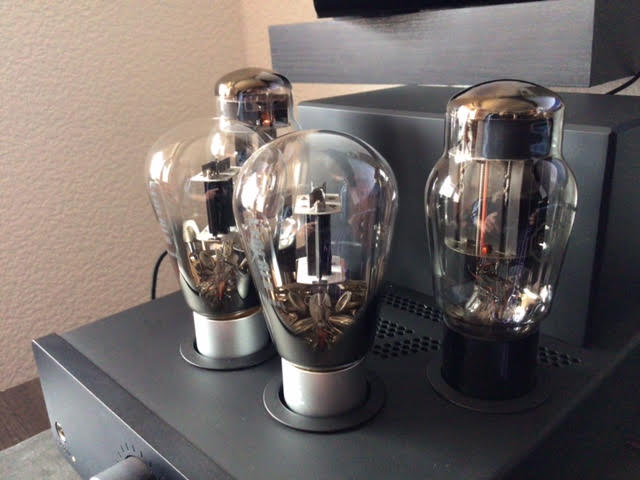
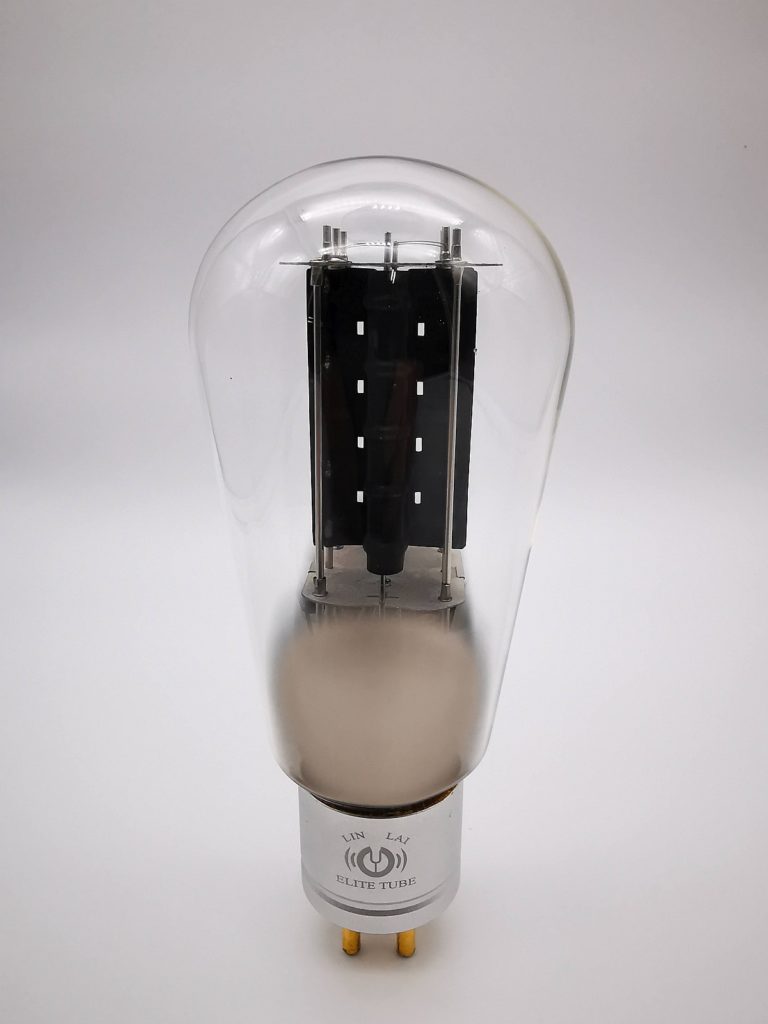
[Linlai™ Global] E-6SN7 with Cary SLP-05 Pre:
Posted Posted in - 6SN7 / CV181, - 6SN7 Tube Purchase Guide, Reviews by Tube Model

Below is review submitted by professional reviewer Robert Grossman (with EnjoytheMusic.com e-zine):

Larger tubes produce a bigger sound; premium tubes create a higher-quality sound…


I’ve been using LinLai tubes in several amps and preamps over the past five years. I offer some perspectives and listening experiences after recently returning to test and hearing the stock Electro-Harmonix 6SN7 tubes in the Cary SLP-05 preamplifier in comparison to the LinLai Global E-6SN7 tubes.

When I purchased the Cary preamplifier about six months ago, I initially burned it in with the stock Electro-Harmonix tubes for about 200 hours. Upon hearing the beautiful, articulate sound of this preamp design, it was time to try other 6SN7 tubes to explore further sound qualities. My first choice was to try the mid-1950s RCA side-getter tubes, since I had heard from a tube seller who had sold many of them to other Cary equipment owners. These were more powerful and engaging-sounding tubes that presented the music’s low end quite well compared to the stock provided Electro-Harmonix tubes. However, the robust sound of the RCA tubes came at the expense of losing a sweet, balanced midrange. I decided to get a quad of matched Linlai (Global) tubes after two months of using the RCA. The Cary preamp uses six tubes, but I had a pair of Linlai (Global) tubes left over from when I used an Aric Motherload XL preamplifier. Because of the LinLai (Global) tube’s reputation for reliability and longevity, that pair could be repurposed into the 5th and 6th sockets of the Cary preamp. I had successfully used the Linlai (Global) tubes in the Aric preamp to achieve a beautiful, balanced, and rich musical result. Now I figured getting another quad to go with the pair that was here would bring the Cary preamp to life, closer to hearing live musicians.

I am a retired bassoonist and was the principal librarian of The Philadelphia Orchestra for 40 years. My endeavors at home these days in retirement are focused on recreating sound in the most musical ways possible. I continue to collect, clean, grade the vinyl condition, and organize the 20,000 recordings here at home, which has been a lifelong pursuit.

The Linlai Global tubes have gone another step in achieving my goals. Once I seated them and turned on the preamp, their jumbo size really stood out! My eyes were surprised at the authoritative and distinguished look, while my ears took notice of the new and bigger sound. These tubes presented all the usual attributes in the narrative of creating a greater realm of reality. There was a greater sense of depth and fullness in the sound that wasn’t just occurring from simply turning up the volume. The quality of
musical resolution, depth of field, and soundstage were clearer and more realistic. With orchestra records, the musical landscape was larger and more resonant, so the acoustical space of a concert hall could be more clearly reproduced and heard, with a greater sense of body in the space. With chamber music, the individual voices and placement of the musicians were better defined, so the perspective of the two violins, viola, and cello in a string quartet felt present in the room with the soundstage image of the Quad 63 speakers. Listening to my bassoon teacher in the Philadelphia Woodwind Quintet record on Columbia Masterworks ML 5613, Sol Schoenbach stood out more while also blending dynamically with the flute, oboe, clarinet, and French horn. This is because the LinLai tubes enabled the Cary preamplifier to convey details and timbre so accurately that my ears found the sound presentations of musicians I personally know to be more realistic.

I love playing piano recordings and find their presentation to be an extremely important test for hearing the interpretations and techniques of the pianists. What could be simpler and more complex at the same time than properly portraying the size, strength, and dynamic depths of a grand piano? I heard them many times, as concert artists performed with The Philadelphia Orchestra or as they warmed up backstage. In this demo, there was a sense of intimacy and vitality as I listened to my former music director play Mozart’s piano sonatas on the DG 7 LP box set 2720-092. I used to hear Maestro Eschenbach practicing when I went into his studio to deliver scores and pick up music for our rehearsals and concerts. These Linlai (Global) tubes allow me to relax and hear the music better while thinking less about the stereo’s technical and analytical aspects.

It takes high-quality, well-designed, and well-manufactured tubes to bring out the very best in a preamp’s contribution to the important beginning of sound amplification for a music system. I know about sound as a musician who has practiced relentlessly, rehearsed countless times, and performed hundreds of concerts since I was a little kid. I looked up technical information and found that some actual construction and design features for achieving musical results involve tubes with larger glass envelopes and larger plates, which allow electrons to flow more effectively. From correspondence and discussions with Rachel at Grant Fidelity, I can tell she has passion, dedication, and a commitment to providing the finest tubes for her customers. She has helped me gain a better understanding of tube choices and results, expanding the performance levels achieved in my systems over the years as I have changed equipment. Thanks for all the recommendations and for supplying premium-quality tubes.”

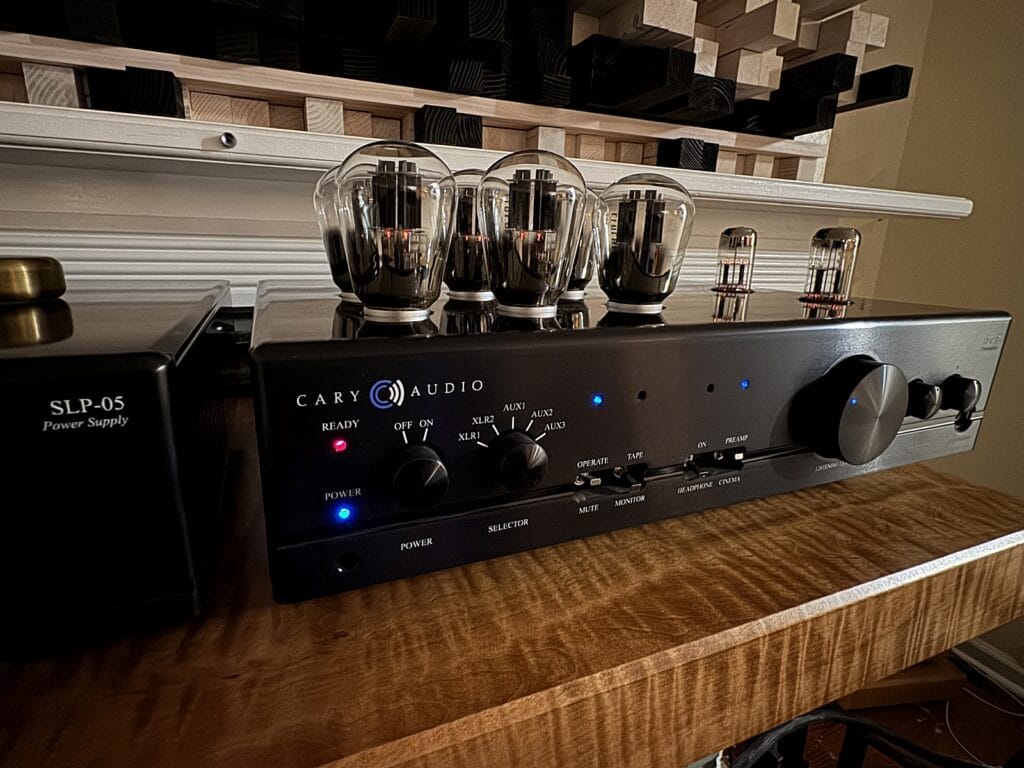
Robert’s equipment picture showcasing the large Linlai Global E-6SN7 tubes in Cary SLP-05 pre-amplifier:

GF-Select 6SN7SE MKII: ‘Totally incredible details in the sound stage and voices’

Posted Posted in - 6SN7 / CV181, - 6SN7 Tube Purchase Guide, - GF-Select 6SN7SE Tubes, Purchase Guide, Reviews by Tube Model

Feedback we received from a recent customer Donald M. via email, which includes comparison between ‘GF-Select 6SN7SE MKII vs. Psvane Summit 6SN7’:

“I just wanted to tell you about the tubes (6SN7SE MKII) that I got from you. I have around 30 6SN7’S and CV181-Z’S old and new. I also have a pair of Psvane Summit 6SN7‘S. The Psvanes are louzy sounding, very scratchy. The best sounding tube’s that I have are the Shuguang CV181-Z’S. The amp that I using with your tubes is a 300B single ended class A amp I built about eight months ago. It’s number eleven amp that I built over the past 60 year’s. I now have eight hours of burn-in time and me and my wife both can’t believe how awesome it is sounding with these tubes. Totally incredible details in the sound stage and voices. I’m telling a friend about them so that he can get a pair of them. Thanks again for all your help.”

A floating piece of glass inside the tube – What is it?

Posted Posted in - 6SN7 Tube Purchase Guide, Purchase Guide, Tube FAQ & Must Read

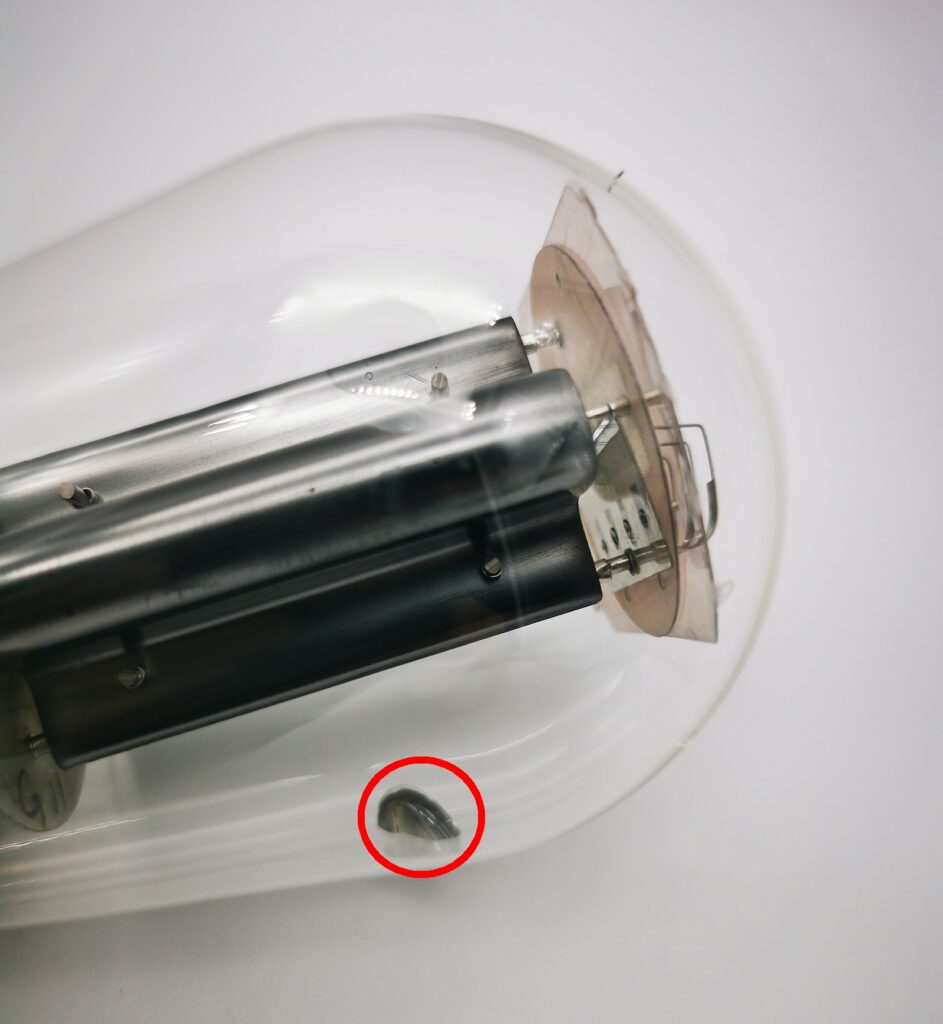
If you have been playing with vacuum tubes long enough, you might have run into a situation that a new tube, shipped from a vendor, arrived with a piece of floating glass inside (see reference picture below). What is it? Where does it come from? Is the tube damaged beyond useful?


Here is the answer:

  1. This piece of floating glass is a broken-off piece from the tube filament glass stem. See picture below showing where it is exactly broken off from.


2. This broken piece is often resulted from the heavy filament structure in vibrating motion during shipping and handling. However, since the tube glass stem is a wide structure supporting the full filament structure – a small piece

broken off from the tip won’t hurt the tube structure’s integrity at all.

3. We see this ‘floating glass’ from TJ Full Music 300B tubes, but not much from other Chinese brand such as Shuguang 300B tubes produced in southern China. Our guess is that the glass supplier for Full Music (located in Northern China) is likely different and glass production technique isn’t exactly the same.

4. This piece of floating glass won’t affect tube function at all and won’t interfere with the vacuum capacity inside the tube. Glass is non-conductive. User only needs to stand the tube up, let the floating piece to fall to the bottom of the tube enclosure, plug the tube into socket vertically, then it is all done!

Customer feedback on GF Premium Tubes:

Posted Posted in - 6SN7 Tube Purchase Guide, - 300B all types, - 845 all types, Purchase Guide

Here is an email feedback we received from customer Thomas L about his personal experience of buying from Chinese vendors vs. Grant Fidelity:

“Hi Rachel,

  Just thought I’d give you a little feedback with my recent purchase.  

  Your tubes are expensive (adding in all the fees and shipping).  I think you would agree as well, although you may argue nothing is cheap with this Audiophile hobby, which I would agree as well. With my recent purchases, I think it was pushing around $2000 CAD.  This was for 5 845s, and two pairs of 300Bs.  Honestly, I had been looking at the GF tubes for a while now, never had the $$ or the guts to pull the trigger as the number of tubes that I need for my amps in total would put a dent in my bank account.  With the boxing day / black friday sales, I figured it would be a good time or timing to replace my existing OEM tubes.  So …. Here’s what I have learned.

  Prior to this purchase, I had been buying tubes online from China or locally from a friend.  But what did I get exactly?
  *  Noisy tubes.  

  *  Tubes that broke after a listening session.  

  *  Tubes that looked like they were shorting out (they were supposed to be new!!!!).

  Then I had to contact my friend or vendor in China to have the tube(s) replaced.  And on one occasion I had to pay duty for the replacement tube.  

  So, after I plugged the GF tubes in my amp(s), I had a moment where I was thinking, “this is what I get for paying a premium price.”  

  The tubes are quiet, like very quiet.  The difference between OEM vs the GF tube is obvious.  I used to think that my amps were noisy, but only after I plugged in the GF tubes, I realized a good amount of noise was actually from the tubes itself. 

  Balanced sound stage.  I am referring to the left and right channels.  With that comes a solid image.  You have vocals that comes directly to you.  I’m particularly picky when it comes to this as I hate to hear vocal lop-sided.

  Last but not least, sound quality.  Smooth, very Smooth but not losing both top and bottom end.

  Overall was it worth it?  The decision is leaning to a Yes.  With the tube and sound quality accounted for.  And most importantly, this is a case where I plugin, dial in and enjoy the music without having to worry too much about reliability (knock on wood, so far so good).  

  Lastly, great service.  Thanks again for the quality products and super fast shipping.

  (Now, I will have to save up again for the next tube upgrades).

Psvane or Linlai™? … Make an informed choice

Posted Posted in - 6SN7 Tube Purchase Guide, Purchase Guide

(The post below has been updated in Dec 2025.)

We have received so many inquires lately from customers asking us to help them to make a choice between the two tube brands out of China. So here is a summary of our take – OBJECTIVELY:

  1. Power of design:

High end product design need vision and dedication. Psvane had a track record of pumping out a few series of high end tubes for the worldwide audiophile upgrade market, since they initially launched ‘Treasure black bottle’ tube series back in 2008 till the recent ACME series.

That original Psvane design team includes the same key personnel who left Psvane to form Linlai. So, Psvane had proven track record. Linlai™ started off with good design strength too. 

Conclusion: 1 for Psvane to 1 for Linlai = Even. We have absolute confidence in Linlai™’s design ability to pump out GREAT hifi tubes. Two brands provide varieties to the market – users can choose based on their own brand preference. 

2. Business focus:

When a business grows, it does tend to increase product offerings to cover more market segments and generate more revenue. Psvane indeed had taken the golden opportunity to expand and filled the market void left by state-owned Shuguang tube factory’s shutdown in 2019 (due to sale of land and relocation – Shuguang now has resumed production in 2023). Psvane even had ambitiously set the stage for expanding into the mass production guitar amp market, which mostly use small signal tubes and EL34/KT88/KT66 etc. (Large triode tubes such as 300B/845 tubes are mostly used by HiFi market.)


Shuguang has resumed production in 2023. Psvane’s market share is certainly being squeezed. More importantly, we think the whole problem of Chinese tubes is about (lacking of) consistent quality. When Psvane grew to cover multiple market segments as Shuguang used to, the quality consistency at Psvane might suffer (this had been unfortunately confirmed by our received Psvane tubes test results before we drop the line in 2021.)

Opposite to Psvane’ aggressive expansion strategy (which was fueled by planned then failed IPO attempt), Linlai set itself as a niche player focusing on HiFi market only and do not appear to aggressively chasing market share at the expenses of quality.

Conclusion: 0 for Psvane, 1 for [Linlai Global] in this round. Psvane tubes quality consistency must be closely observed by diligent buyers.

3. Seeing is Believing. Numbers talk:

We have randomly taken 28 (300B) tubes from each brand that we have received and plotted their emissions. Blue line is Psvane, Orange line is Linlai™. We can clearly see a less deviation with Linlai™ measurements than with Psvane.

What does this chart tell us? It says: We are indeed getting superior quality [Linlai™ Global] tubes with consistent measurements than those we got from Psvane in the past. (Note: We cannot speak for Linlai tubes without [Linlai Global] label, due to lack of first hand measurements.)

In our opinion, those Psvane 300B tubes with plate current less than 45 (75%) should NEVER has been released to outside of China market. (We were told that China’s national standard only requests minimum 36 (60%) emission for 300B tubes – it appears to be reasonable in 1960’s but we don’t agree it should be extended to 2020’s when Chinese tube price has skyrocketed).

4. What if? – The Warranty question:

Both Psvane and Linlai offer a better warranty term than the state owned Shuguang brand used to offer. They are changing the reputation of ‘Made-in-China’ tubes.

Linlai factory backs up their [Linlai™ Global] tubes sold through their own website and their authorized overseas resellers. Buyers tempted by cheaper price and bought the Chinese version of Linlai tubes (it doesn’t have the [Linlai™ Global]) is only covered by their sellers (mostly located in Greater China). 

Conclusion: Buying [Linlai™ Global] tubes does not leave the buyer to hold the bags when problems arise. Consistent quality with [Linlai Global] tubes means less warranty cases – it translates better user experience. 

5. How do they compare, sonically?

We know this is the holy-grail question for audiophiles. But since this comparison is all about being ‘objectively’. We as vendor must leave this question to be answered by the audiophile community.

Objectively, we can shine some lights on Linlai™ design which will add to definite positives to the sonic performance. E-series with molybdenum material produce a much stronger electron emission than other type of plate material such as graphite or hybrid plate, and sustain higher voltage. This translates to more dynamic to the sound, better reliability and longer tube life. DG overhang filament series achieves better vibration control than other filament structures. With all these features, we trust that they are evident to well trained audiophile ears to hear the sonic improvements.

Conclusion: we have been selecting high quality tubes from China for 17 years now. Our past combined experience does tell us that Linlai™ is a brand with great potential for both sonic quality and reliability – so far we have not seen a single defective tube from our 4 Linlai™ shipments, except one tube broken in handling from China to us.

We hope by sharing the above information and data, worldwide music lovers and audiophiles can be confident in making a well informed choice between Psvane and Linlai brands.

Keep in mind: Enjoying music is a journey, so is tube rolling. It’s not a quest for the absolute best. If there were ‘absolute best’ sonic in the audiophile world, we wouldn’t have had today’s numerous HiFi brands competing at audio shows. Pricing is indicative of quality. If a product’s pricing is not in alignment with its quality, it will simply not last long on the market.

Happy Listening.

Rachel@ Grant Fidelity


6SN7SE with HeadFi: Inspire by Dennis Had IHA-1 Dragon Version – ‘The tubes are magnificent.’

Posted Posted in - 6SN7 / CV181, - 6SN7 Tube Purchase Guide, Purchase Guide, Reviews by Tube Model

Feedback received via email from Kirk V. in USA:

“The tubes are magnificent. The change in musical quality is astonishing. This is the best investment I have made after spending thousands to improve the signal path. I cannot believe how much music I have missed until now. 
Kirk”

Linlai™ Global E-6SN7 on Feliks Euforia Headphone amp: from Germany

Posted Posted in - 6SN7 / CV181, - 6SN7 Tube Purchase Guide, Purchase Guide, Reviews by Tube Model

We have just received the feedback below from Greg K from Germany! Greg owns a ‘Feliks Euforia headphone amplifier’ which came with Psvane CV181-TII as driver tubes.

Read about his first impression after swapping to [Linlai™ Global] E-6SN7 for 26hrs – it might help those who wish to know how the E-6SN7 compared to Psvane tubes: (note: Linlai tubes full burn-in will take approximately 100hrs)

“I have now burned in the tubes for a good 26 hours so far.And on the Feliks Euforia, where the Psvane CV181-TII were before, a lot has happened. I listened with the Audeze Lcd 2 C headphones which are quite neutral. And relabelled 6080 Sylvania power tubes which also arrived on Saturday.

Compared to the Linlai Global E-6SN7, the Psvane are quite neutral in sound. I noticed this immediately after the exchange. This is no longer the case with the Lin Lai, they play much warmer.

The bass has increased considerably where before they were bloodless in direct comparison to the Psvane CV181-TII. The good thing about the Linlai is that the mids and highs are relatively unchanged compared to the Psvane CV181-TII. I didn’t notice any loss there, they seem to have gained a bit of sparkle.

They are also more accurate, closer to the music and go a bit deeper in the highs and a bit longer in the low end. Detail resolution is also very good, I like it better than the Psvane tubes.

Vocals are a bit more distant and more central than with the Psvane, or less voice accentuated, which I personally find better.

All in all, they are definitely worth the money and improve the sound of the Feliks Euforia dramatically. Before I was always getting disturbed by something, but that has gone since the first hour since the Linlai have been in. I don’t regret buying them. Much more the Psvane that you can book at Feliks.

It makes the Feliks neutral but cold, with the Linlai it’s just the opposite.

That was my first impression and I know they still need a little time to burn in. But they are getting better by the hour. Linlai has done a really good job. It also shows that after such a short time they are already so open and show the direction they are going in.

I am enthusiastic about the tubes. And I wanted to tell you that much about how good they are in the first hour.

With Kind regards
Greg”

Is the ‘Top 10% Best of Best Grade’ worth the money?

Posted Posted in - 6SN7 Tube Purchase Guide, Purchase Guide

You may have noticed that our tube offerings are priced to different gradings – the best, also the most expensive, grade is ‘Top 10% Best of Best Grade’ at a price premium over typical ‘factory QC pass grade’.

Is the ‘Top 10% Best of Best Grade’ worth the money? What are you paying for the best grade?

Tubes, like most bulk commodities, are graded according to their tested parameters from lab equipment. Although vacuum tubes are industrial products, they are not cookie-cutting universal exactly the same when rolling off the production line. Consider tubes like premium coffee beans: They are all coffee beans, but not all the same coffee beans, and are not sold at all the same price.

Tubes are hand-made products. Many human factors play into the final quality and lifespan of tubes. Tubes are also live creatures – they are not in static fixed state through their lifespan – they change with the environment they work in, and change itself unexpectedly like a ‘living creature’.

An example on 300B tubes:

A factory QC pass grade 300B tube can have 60-70% of full emission but still considered ‘QC pass’ by a tube factory. Our selected ‘top 10% Best of Best grade’ will have minimum 85% up to 110% of full emission. The top grade will have approximately extra 30%-50% emission (in comparison terms between the two grades) to allow your tubes last much much longer.

Additional screening of our ‘Top 10% Best of Best Grade’ also have matched transconductance to the best possible range and no other imperfections in tested specs.

Why called top 10%? Because these tubes only take about 10% of the entire tube production batch. They are rare and hard to come by, when ALL parameters considered.

This comparison on 300B grading also applies on other tube models.

If budget isn’t an issue, we as buyers would personally go with top 10% best of best grade on these high end tubes, to make sure to get the best possible commodity for longest time enjoyment. 

Hope this helps with your tube purchase selection!

Rachel @ Grant Fidelity

Can your 6SN7 replace my 6SN7GT, 6SN7GTA, 6SN7GTB?

Posted Posted in - 6SN7 / CV181, - 6SN7 Tube Purchase Guide, Purchase Guide

We sometimes receive amp owners question about tube substitute related to 6SN7. Here is a short summary:

  1. GT stands for ‘Glass Tube’.
  2. GTA is an enhanced version of original GT version – to allow higher plate dissipation than the GT version.
  3. GTB is variant of GTA, with a heater warmer control to further enhance reliability when this tube was used in TVs.
  4. Very early 6SN7 tubes can handle max 300V. Today’s new production 6SN7 tubes can handle max 450V.
  5. In short, new production 6SN7 can replace your old 6SN7 without frying the tubes. But you should not use a NOS 6SN7 designed to handle 300V, into a modern circuit of 450V.
  6. All our listed 6SN7 tubes (no matter what suffix it has) can electronically replace 6SN7GT, 6SN7GTA, and 6SN7GTB.
  7. Do check dimension clearance to make sure the different glass bulb shape can fit into your amp space!

Happy tube rolling!

6SN7SE Globe Tube Tips – ‘You Raise Me Up’

Posted Posted in - 6SN7 / CV181, - 6SN7 Tube Purchase Guide, Purchase Guide

Some amps have preamp 6SN7 tubes placed in a very tight real estate – i.e. two tubes are placed very closely to each other so the new high end 6SN7 with curved larger / wider glass enclosure cannot fit in side by side.

A customer from Europe recently told me his solution and I think it is worthwhile to share! That is – use a socket saver to raise one of the tubes up!

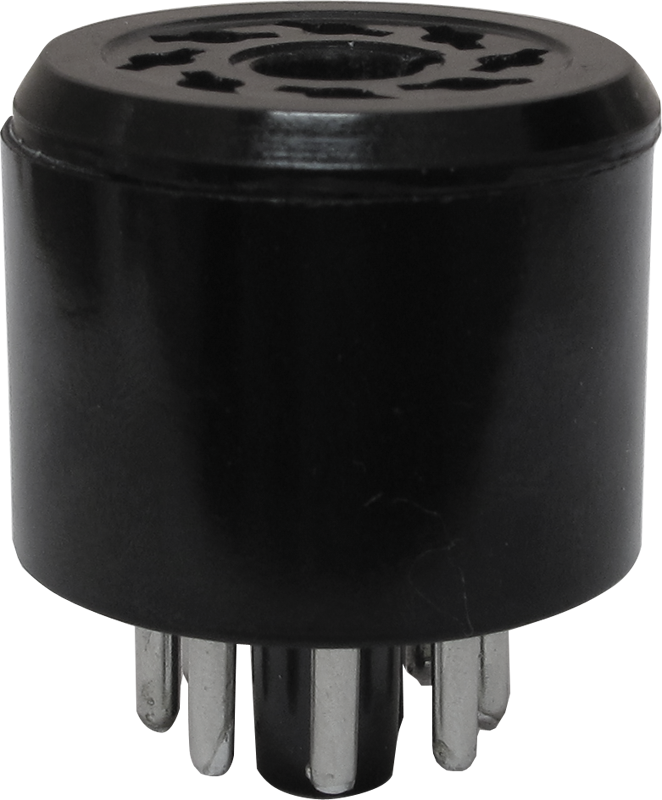
Just google ‘8 pin socket saver’ (not ‘socket adapter’ which may change pin layout connections) and make sure to purchase from a reputable audio parts vendor. Some lower quality socket saver can introduce current leakage to your circuit and cause unexpected noise issues.

Happy Listening!